

Decentralized finance reshapes how investors interact with crypto markets. At its core lies a protocol enabling peer-to-peer trading without banks or brokers. This system uses automated market makers to match buyers and sellers, ensuring 24/7 access to digital assets.
The platform’s $1 trillion lifetime trading volume reflects its dominance in the crypto space. Users retain full control of their funds while earning fees by contributing to liquidity pools. Current metrics show the native token trading at $11.19, backed by a $6.87 billion market cap.
What makes this ecosystem unique? Community governance allows token holders to vote on upgrades and fee structures. Unlike traditional exchanges, no personal data gets shared—trades execute directly from self-custodied wallets.
Liquidity providers face challenges like impermanent loss but gain opportunities through strategic pool selection. This guide explores how to navigate risks while maximizing returns in decentralized markets.
Key Takeaways
- Decentralized exchanges eliminate intermediaries, letting users trade directly from personal wallets
- Liquidity providers earn fees proportional to their stake in trading pools
- Protocol governance tokens offer voting rights and potential value appreciation
- $1 trillion+ lifetime volume demonstrates market trust in the platform
- Impermanent loss risks require careful strategy when selecting asset pairs
Overview of Uniswap (UNI) in the DeFi Landscape
Peer-to-peer crypto trading eliminates traditional barriers to market entry. This protocol redefined value exchange in 2018 by replacing intermediaries with self-executing smart contracts. Its automated market maker system lets users swap tokens directly from personal wallets—no sign-ups or third-party approvals required.
The platform’s growth mirrors Ethereum’s rise as a smart contract powerhouse. By shifting from order books to pooled liquidity, it solved the “cold start” problem faced by early decentralized exchanges. Traders now access over 1,800 token pairs through community-funded reserves.
Three factors drive its dominance in the decentralized exchange sector. First, its open-source code allows seamless integration with wallets and yield farms. Second, fee structures incentivize liquidity providers to stabilize markets. Third, governance tokens let users shape protocol upgrades—a radical departure from centralized platforms.
This ecosystem thrives on transparency. Every transaction lives on-chain, creating auditable markets resistant to manipulation. While volatility persists, the protocol’s $1 trillion+ lifetime volume proves traders trust algorithmic pricing more than corporate-controlled order books.
Uniswap UNI: Key Features and Operational Mechanics
Automated market makers redefine value exchange through code-driven liquidity. This protocol executes trades via self-executing smart contracts, removing intermediaries from every transaction. Users simply connect compatible wallets to access instant swaps across thousands of digital assets.
The system’s architecture supports direct ERC20 conversions without predefined pairs. Want to trade Ethereum for a newly launched token? The protocol automatically routes through optimal liquidity pools, splitting large orders across multiple reserves to minimize price impact.
Version 3 introduces game-changing upgrades for market participants. Concentrated liquidity lets providers allocate funds to specific price ranges, boosting capital efficiency by up to 4000x compared to earlier iterations. Traders benefit from tighter spreads, especially for stablecoin pairs and correlated assets.
Key operational advantages include:
- Non-custodial swaps through MetaMask, Coinbase Wallet, or other Web3 interfaces
- Permissionless pool creation for any ERC20 token combination
- Dynamic fee structures adjusting to market volatility (0.01% – 1% per trade)
This infrastructure empowers both novice and experienced users. While centralized platforms require KYC checks, here you maintain full asset control – private keys never leave your device. The protocol’s open-source nature ensures continuous innovation, with developers worldwide contributing to its evolution.
The Mechanics Behind Liquidity Pools and the Constant Product Formula
Decentralized exchanges rely on mathematical foundations to power peer-to-peer trading. At their core lies a simple equation governing every transaction: x × y = k. This formula ensures liquidity pools maintain balance while enabling seamless asset swaps.
Understanding the Constant Product Formula (x * y = k)
The formula works by keeping the product of two token quantities constant. Imagine a pool containing 100 ETH and 10,000 DAI. The constant k becomes 1,000,000 (100 × 10,000). When traders buy ETH, DAI enters the pool – but the product always stays 1,000,000.
Here’s what changes:
| ETH Withdrawn | DAI Added | New ETH Price (DAI) |
|---|---|---|
| 1 | 101.01 | 101.01 |
| 5 | 526.32 | 105.26 |
| 10 | 1,111.11 | 111.11 |
Impact on Token Pricing and Trade Execution
Token ratios directly determine market prices. If a pool holds 1,000 Token A and 500 Token B, each A costs 0.5 B. Large trades shift these ratios significantly – a $10,000 swap might move prices 5%, while $100,000 could cause 20% slippage.
The system self-regulates through three mechanisms:
- Automatic price adjustments with each trade
- Incentives for arbitrageurs to correct imbalances
- Built-in liquidity depth based on pool size
This mathematical approach creates self-sustaining markets. While centralized exchanges use order books, decentralized platforms let code manage supply and demand through transparent rules.
Exploring Impermanent Loss in Uniswap Pools
Market volatility creates hidden costs for crypto investors participating in liquidity pools. When paired assets experience price divergence, providers face temporary value erosion compared to simply holding tokens. This phenomenon becomes critical during sudden market shifts.
What is Impermanent Loss?
Imagine depositing equal values of ETH and DAI into a pool. If ETH’s price surges 50% while DAI stays stable, arbitrage traders will rebalance the pool by buying cheaper ETH. Your share now contains less ETH than if you’d held both tokens separately – that’s impermanent loss.
| Price Change | Impermanent Loss |
|---|---|
| 1.25x | 0.6% |
| 2x | 5.7% |
| 5x | 25.5% |
The loss remains “impermanent” until you withdraw funds. Prices could revert, eliminating the deficit. However, prolonged divergence turns paper losses into real ones.
Mitigation Strategies for Liquidity Providers
Three approaches reduce exposure:
- Stable pairs: Trade correlated assets like USDC/DAI where price ratios rarely shift
- Range orders: Concentrate liquidity where prices will likely stay (e.g., ETH between $3,000-$3,500)
- Fee optimization: Prioritize pools with higher trading activity to offset losses through accumulated fees
Advanced users combine these tactics with yield farming. By earning additional reward tokens, providers can counterbalance potential value erosion. Timing matters too – entering pools during low volatility periods reduces immediate risks.
Effective Liquidity Provider Strategies and Earning Fees
Strategic liquidity provision transforms passive holdings into active income streams. Savvy participants combine market analysis with risk management to optimize returns. Let’s explore proven methods for balancing earnings with exposure.
Maximizing Returns Through Pool Selection
High trading volume pools generate more fees but often carry higher impermanent loss risks. Target pairs with consistent activity and moderate price correlation, like ETH/wrapped BTC or stablecoin combinations. Analyze historical data using blockchain explorers to identify fee accumulation patterns.
Fee tiers directly impact profitability. Consider these structures:
| Fee Tier | Best For | Example Pairs |
|---|---|---|
| 0.01% | Stable assets | USDC/DAI |
| 0.30% | Mid-volatility | ETH/MATIC |
| 1.00% | Exotic tokens | MEME/NFT |
Advanced Deposit Strategies
Concentrated liquidity lets providers focus capital where price action occurs most frequently. Allocate 80% of funds within 10% of current market prices for volatile assets. For stable pairs, spread liquidity across the entire range to capture fees from arbitrage trades.
Reinvest earned fees weekly to compound returns. Automate this process through yield aggregators that stake rewards back into pools. Monitor gas costs – batch transactions during low network congestion periods to preserve profits.
Uniswap Price Trends, Trading Volume, and Market Dynamics
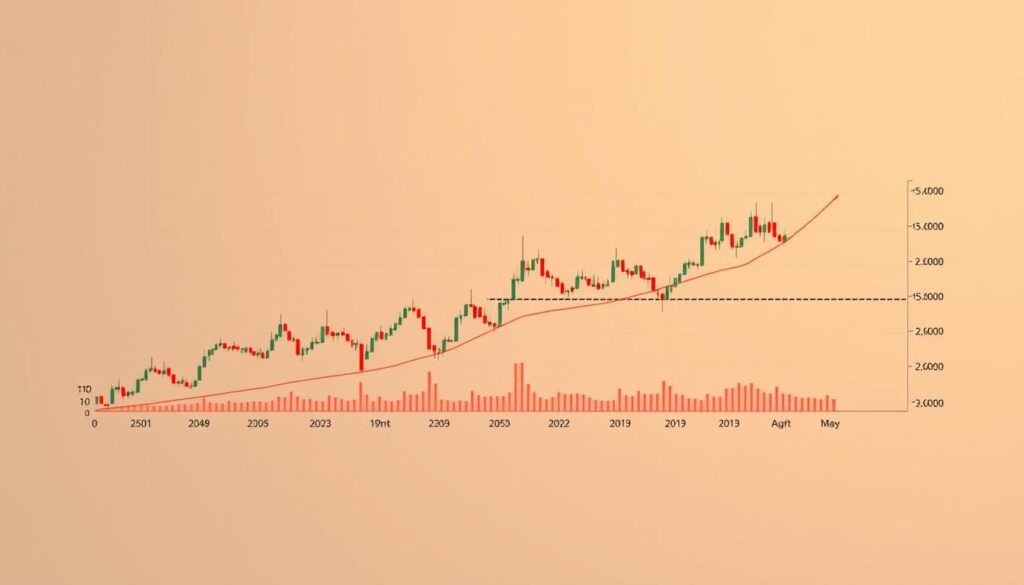
Market cycles reveal distinct patterns shaping asset valuations in decentralized ecosystems. The platform’s native token surged from $0.47 at launch to a record $45 during 2021’s bull run—a 9,400% increase fueled by DeFi adoption. Current valuations at $11.19 suggest accumulation phases as traders position for potential rallies.
Historical Price Movements and Market Extremes
Three critical phases define the token’s journey:
| Period | Price Range | Catalyst |
|---|---|---|
| Sep 2020 | $0.47 – $3.80 | Protocol launch |
| May 2021 | $45 (ATH) | DeFi summer peak |
| 2023-2024 | $4.50 – $12.60 | Market recovery |
Daily trading volumes exceeding $500 million confirm strong liquidity. This activity helps minimize slippage for large orders—a key advantage over smaller exchanges. Chart analysis shows recurring support near $10.50, with resistance tests at $13.20 during Ethereum network upgrades.
Seasonal trends emerge when overlaying price action with broader crypto cycles. The token typically outperforms during Ethereum ecosystem developments, as seen in March 2024’s 22% rally following Layer-2 expansion news. Use moving averages and RSI indicators to spot entry points before major protocol updates.
While past performance doesn’t guarantee results, understanding these patterns helps time strategic positions. Combine technical analysis with fundamental metrics like governance participation rates for informed decisions.
Leveraging BISON for Seamless Uniswap (UNI) Trading
Navigating decentralized markets requires tools matching their innovation. BISON bridges this gap with a regulated gateway to crypto assets, backed by Germany’s Stuttgart Stock Exchange. Over 970,000 users leverage its intuitive design to buy cryptocurrencies without managing private keys or liquidity pools.
Streamlined Access for Modern Traders
The platform removes technical hurdles like wallet integrations and slippage calculations. Instead, users execute trades through a familiar exchange interface – think stock trading simplicity applied to digital assets. Real-time charts and portfolio tracking tools help strategize positions while monitoring market shifts.
Three pillars define BISON’s competitive edge:
| Feature | Traditional Exchange | BISON |
|---|---|---|
| Fees | 0.1% – 0.5% per trade | 0% on transactions |
| Security | Variable custodial risks | Institutional-grade protocols |
| Learning Curve | Advanced DeFi knowledge needed | Demo mode + guided tutorials |
Newcomers practice risk-free with virtual funds, testing strategies before committing capital. Seasoned traders appreciate fee-free models – every dollar stays invested rather than lost to transaction costs. Mobile apps deliver these features anywhere, syncing across iOS and Android devices.
BISON’s regulatory compliance offers peace of mind missing in many crypto platforms. As decentralized ecosystems evolve, such bridges between traditional finance and Web3 become essential for mainstream adoption.
Decentralized Exchange (DEX) Advantages Over Centralized Platforms
Why choose decentralized exchanges when trading digital assets? These platforms eliminate third-party risks by letting you execute transactions directly from your wallet. No middlemen means no single entity can freeze funds or manipulate markets.
Privacy stands as a core benefit. Unlike traditional exchanges demanding passports or Social Security numbers, DEXs require zero personal data. You trade cryptocurrencies anonymously – ideal for those valuing financial confidentiality.
Round-the-clock availability reshapes market participation. While Wall Street sleeps, decentralized platforms process transactions 24/7. Weekend crypto swings? Holiday price movements? Trade through them all without interruptions.
Key Differentiators
- Asset control: Hold private keys instead of trusting exchanges with custody
- Global access: Trade from regions with strict banking regulations
- Reduced hacks: Distributed infrastructure lacks centralized attack points
Centralized platforms control your funds like banks. DEXs flip this model – you manage security through self-custody wallets. Lose your keys? That’s on you. But gain freedom from exchange bankruptcies or regulatory seizures.
| Feature | Centralized | Decentralized |
|---|---|---|
| Funds Control | Exchange holds keys | User holds keys |
| Verification | Mandatory KYC | None required |
| Market Hours | Limited by operator | Always active |
This shift empowers investors worldwide. Whether you’re in New York or Nairobi, access remains equal. Combine this with lower fees and censorship resistance, and decentralized models redefine what exchanges can achieve.
Governance, UNI Token Distribution, and Community Involvement
Decentralized systems thrive when users directly influence protocol evolution. The platform’s governance model turns token holders into decision-makers, voting on upgrades ranging from fee adjustments to treasury allocations. This structure ensures no single entity controls development priorities.
The Power of Collective Ownership
September 2020 marked a watershed moment. Over 250,000 early users received free governance tokens through a historic airdrop – 60% of total supply distributed in hours. This move shifted control from developers to community members, cementing true decentralized ownership.
Hayden Adams, the protocol’s founder, envisioned this model while coding at his kitchen table. His mechanical engineering background shaped the system’s precision. Venture firms like Paradigm provided early funding, but community governance now drives strategic choices.
Balancing Investor and User Interests
Governance proposals require careful negotiation between stakeholders. Token holders can:
- Adjust liquidity mining rewards
- Allocate development funds
- Modify trading fee structures
Recent votes demonstrate this balance. A 2023 proposal to redirect 0.01% of swap fees to treasury passed with 72% approval. Such decisions show how communities evolve protocols without corporate oversight.
The system’s 1 billion token supply remains governed by transparent rules. With 43% still awaiting distribution through incentives, users maintain power to shape decentralized finance’s future.
Bringing It All Together: Navigating the Dynamic Uniswap Ecosystem
The decentralized exchange landscape continues evolving as participants balance opportunity with calculated risk. With a $6.87 billion market cap and 628 million coins circulating today, this platform demonstrates robust staying power in volatile markets. Its total supply of 1 billion tokens leaves room for strategic distribution through governance incentives.
Monitor the price chart alongside trading volume trends to time entry points effectively. Assets in liquidity pools perform best when paired with fee optimization strategies – stablecoin combinations during sideways markets, volatile pairs when momentum builds. Remember: 24/7 access means price shifts can happen any time, requiring constant vigilance.
Three rules guide success here. First, diversify across pools to mitigate impermanent loss. Second, reinvest earned fees during low-gas hours. Third, track supply metrics – circulating coins impact both liquidity depth and token valuation. These practices turn market participation into a disciplined art form.
The ecosystem thrives when users leverage its transparency. You hold the keys – literally and figuratively – to shape decentralized finance’s future while earning from its growth. Stay informed, stay agile, and let code-driven markets work for you.

